

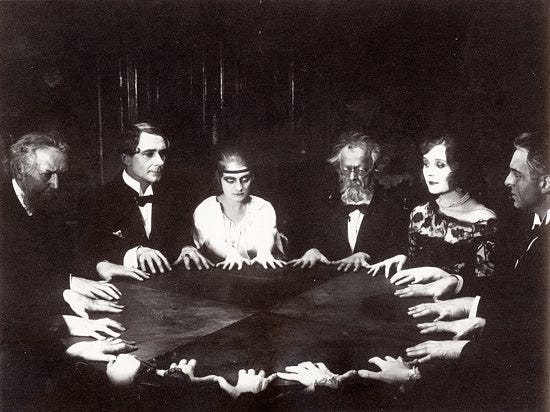
After the war and the influenza that followed it, a whole generation was in mourning — and the dead had never felt so close. All you had to do to reach them was sit in a dark room and pay the woman at the head of the table.
*
We remember the early 1920s for the glitz, the glamor, the champagne and the jazz. We tend to forget that what came just before that hedonistic time was a war that took thousands of young men, followed by a pandemic that took millions more around the world. Nearly every family had lost a loved one. And into that aching grief came someone who offered comfort and relief. The medium.
Spiritualism was not just a curiosity. It was a craze. Grieving mothers and widows paid, often quite a sum, to sit in a darkened parlor in the hopes of hearing their beloved’s voice, or to be given a secret message that only the departed and the grieving could have known. Séances became a fashionable evening’s entertainment, and spirit boards, or Ouija boards, became a popular commodity.
The most remarkable convert to Spiritualism was Sir Arthur Conan Doyle, the man who invented Sherlock Holmes, the most coldly rational mind in all of fiction. After losing his son not long after the war, Doyle became Spiritualism’s tireless evangelist, touring the world to lecture on the reality of the afterlife. The creator of literature’s greatest skeptic spent his final years as its greatest believer, not only supporting mediums but also evangelizing for them.
On the other end of the spectrum, Harry Houdini, the world’s most famous magician and escape artist, made it his mission to expose the fraudulent mediums preying on the grieving. A master of illusion, he knew all the tricks and tools of the trade: the concealed threads and rods that set furniture moving, the cheesecloth passed off as ectoplasm, or the medium cracking her own toe joints beneath the table to produce the spirits’ rapping. He attended séances in disguise, exposing one medium after another. He even sat on a Scientific American committee that offered a fortune to anyone who could demonstrate a genuine psychic gift under controlled conditions — and no one ever claimed it. “It takes a flimflammer to catch a flimflammer,” he said.
Doyle and Houdini had been great friends. Unfortunately, their opposing beliefs caused an irreparable rift in that friendship. Knowing how much Houdini still grieved his mother, Doyle’s wife offered to reach her through automatic writing, a practice in which the spirits were said to guide the medium’s hand across the page. She produced pages of it, and her husband was certain it was real. But Houdini’s mother had been a Hungarian immigrant who never mastered the English language and the message flowed in fluent, elegant English she could never have written. For Houdini, the woman on the page was not his mother. For Doyle, doubting his wife’s gift was an insult he could not forgive. The friendship never recovered.
So were the mediums of that time monsters, preying on the broken-hearted? Many of them, certainly. The tricks were real, and the price charged for them was substantial. And yet, I find it hard to believe that Doyle was a fool, or a liar, and he obviously received great comfort in his convictions. For every fraud duping a grieving widow, widower, lover, or child, there were those who slept that night for the first time in a year.
Nineteen-twenties Hollywood ate this up. And when I was writing the Grace Michelle Mysteries, I wanted to recapture that phenomenon in the series. In Grace in Hollywood, the second book in the series, one of my favorite characters is Lenora Lange, a serene, silver-haired spiritualist who gives Grace both pause and comfort in equal measure. I won’t tell you exactly how, as I don’t want to give anything away, but I can tell you that Lenora’s séances draw some pretty celebrated guests to her table — including the great romantic hero Rudolph Valentino himself, who, like a surprising number of the era’s stars, was a genuine believer. And Grace, who prides herself on seeing through a performance, cannot decide whether she is watching the cleverest cold reading of her life, or something she has no rational way to explain.
That, to this mystery writer, is the perfect character to drop into a story. Con artist, or comforter, when someone claims to speak for the dead, she is the one I always want to watch most closely. Especially when the dead in question were murdered.
You can pull up a chair at Lenora’s table in Grace in Hollywood, one of the Grace Michelle Mysteries.
But tell me first, if you attended a séance and the voice at the head of the table told you something only your lost person could have known, would you call it a trick? Or would you want, just for a moment, to believe?
Love this topic. Thanks for putting the trend of spiritualism in its historic context.